Monday, 4 January 2016

The Joy of Maps

I love maps. They're so inspiring. Looking at a world map just reminds me how much of the world is still out there to explore. It's not just world maps though. There's so many maps out there, the inspiration is endless. Here's a few of the ones I have in my house.

Ordnance Survey Maps

My dad's big on walking, so we've got a good stack of these. I like them as much for the history behind place names and such as for their actual help for finding walking routes. Sometimes I'll spot something on one of these maps and just have to look it up because, really why are there so many places marked "cold harbour" down the Lincolnshire coast?

Selection of ordnance survey maps of Great Britain

Atlases

Both the traditional atlas - i.e. here are maps of the entire face of the globe - and a more fun version with lots of extra little details about the population and culture of each country. Hours can easily be wasted tracing paths across these, imagining journeys you could make.

Readers Digest World Atlas and childrens' "Maps of the World" book

And atlases for fictional realms

I'm a bit of a Tolkien fan. Just a bit... Combining Tolkien with a love of maps resulted in the purchase of this little gem. It's been well-loved. Mostly in my attempts to work out just how far the Fellowship travelled across Middle-earth. Not sad. Not at all...

Karen Wynn Fonstad's Atlas of Middle-Earth

Books about maps

Because the history of cartography is every bit as interesting as the actual maps themselves. Which is why I have these.

Two books about the history of cartography (On The Map by Simon Garfield & Map of a Nation by Rachel Hewitt)

The oldest world map (possibly)

Not one of mine, but I found this in the British Museum. It's mentioned in one of the books above. It's Babylonian and possibly the oldest world map in existence. Isn't it wonderful?

A clay tablet incised with a diagram of the known world, dated c. C5th BC

Museum maps

OK, so if the things above weren't a little bit sad and obsessive, these certainly are. But I promise you, if you're in a rush trying to see things in any of London's big museums, these maps are lifesavers. Why wander round hoping you'll be able to find that exhibit you really wanted to see when you can pick it out on a map and go straight there?

Selection of floor plans from London museums


... I have no idea why I keep them...

Wall maps

My sister gifted me this for Christmas. I'm in love with it because I'm a small child at heart and it has marker pens and magnets. And why not? Who wouldn't love to mark their adventures on a map?

Dry wipe map of the world with pens and magnets for marking routes and destinations

Digital maps

Of course, I can't take that wall map with me, so I created this one using a basic outline from the interwebz. It's colour-coded according to places I've been, places I'm going or would like to go in future. What better incentive to explore more of the planet than all those grey/purple/yellow patches that need colouring in?

Colour-coded map of the world created in GIMP to show places visited and places still to go


I'll admit my love of maps borders on the obsessive, but what maps do you enjoy? Do they give you inspiration for future travels? Why not share in the comments?

Friday, 1 January 2016

The Grand Tour: 6 Months To Go

First off, Happy New Year and all that jazz.

Second, apologies for the recent lack of posts. Let's hope I can make up for that (unlikely...).

Third, it's now less than 6 months until my planned departure date for the Grand Tour, my hopefully epic trip round the world. Thanks to lovely presents from family, I'm starting to gather together all the bits and bobs I'm going to need. Little things like a head torch, first aid kit and a compact sleeping bag.

Perhaps more importantly, I'm pretty sure I'll be booking my first flight and hostels in the next few weeks. I've been warned that accommodation in Iceland books up pretty quick in the summer months and as that's my first stop and possibly the most expensive stop (based on per day costs), I want to get that sorted out soon.

I had originally planned to make my way round the entire island on buses, but looking at accommodation costs I think I'll actually base myself out of Reykjavik and Akureyri and explore from there - accommodation is marginally cheaper there. No worries - the buses are still going to come in handy.

So that's Iceland. But what else do I need to sort out in the next 6 months?


Vaccinations

Ugh. How delightful. Thing is, I'm planning on going a few places where I have to have jabs. For example, I'm going to Peru and while Peru has no vaccination requirements, because I'm stopping there, future stops like Cambodia and South Africa require me to have been vaccinated against Yellow Fever. Fun.

Aside from that though, it looks like I might be able to avoid getting too many others. I've had jabs previously for rabies and Hepatitis B in the last 5 years, which are (Doctor Google says) long-lasting. My typhoid jab will probably need redoing and possibly my Hep A. But everything else... looks like I'm getting off light.Yay.

Visas

This is going to be fun. Good job I've included these in my budget because they're soon adding up. Currently I need to sort out visas (or visa waiver details) for Canada, the US and Australia, plus making sure I add in the cost of visas or other approvals on arrival in Chile and Cambodia. All the fun.


Right at this moment though, I'm going to crack out the world map my sister gave me for Christmas. It has magnets and marker pens so I can mark my route. It will be awesome. I'm a small child at heart.

On with the planning. Planning, planning, always planning. Ah, the joys of a round the world trip!

A laptop, travel guide and notebook ready to plan some epic travelling

Friday, 11 December 2015

Hostelling: Is it for you?

I spent my lunch break today trying to find relatively cheap accommodation in Iceland for the first leg of the Grand Tour. Outside Reykjavik, hostels seem to be few and far between and also much more expensive than other places I've been.

It got me thinking, though, about hostelling in general and whether everyone's cut out for it. So here's my list of clues that hostelling might be a good choice for you.

1. Sharing a room isn't a bother

Sharing a dorm with half a dozen or more complete strangers is the norm in hostels. OK, so you could pay a few quid more and get a private room, but that's not really the point of hostels, is it? If you're fussy about personal space or freaked out by sharing with strangers then you might want to stick with hotels.

If you're not, well done! First hurdle overcome.

2. Patience is a virtue when needing a shower

Let's face it, queuing for a bathroom is no one's idea of fun, but it's a fact of life in hostels. If you absolutely must have a shower every day, try to get in there outside of "rush hour". If you're like me, you can cope with a shower every other day with a good wash in between. Cuts down on the queuing.

If you can't bear the thought of sharing a bathroom, bag a private room but you'll have to pay more. If you're with a group, best get a hotel.

3. Cooking is fun

Hostels are self catering. Obviously. And I'm guessing that if you're staying in a hostel, you're trying to keep costs down, which means few meals out. Which means cooking for yourself. So, you'd best like cooking or at least be able to cook something other than beans on toast.

As with bathrooms, try to hit the kitchen outside of peak hours, especially if it's small. I stayed in a hostel in New Zealand that had such a tiny kitchen for the size of the place that I didn't actually eat the one night I was there because I couldn't get anywhere near the cooker. Don't make the same mistake. Scope the place online if you can before you book.

4. Noise? What noise?

When hostelling, you just have to accept that sometimes you're going to have roommates who clatter in at 3am and wake everyone up. Sometimes it might even be you. If you can't cope with the occasional disturbance, you might want to reconsider. You could try investing in some earplugs if you still intend to stay in hostels but don't want to get woken up.

5. Respect

Perhaps the most important thing when staying in hostels (and life in general). You're never going to cope if you don't respect your fellow guests. So yes, one of your roommates rolled in drunk and woke everyone up. Shit happens. Kitchen too busy? Don't snark at the people using it - it's not necessarily their fault. Maybe nip out for a takeaway instead? Queue for the shower several miles long? Screw it. Grab some deodorant, have a quick wash at the sink and get out there - chances are, no one will notice if it's just one day.

Just because a hostel is cheaper, doesn't mean you can't have an amazing experience there. Take the lovely Malin Beg Hostel for instance.


This was the cheapest night of my trip to Ireland. It's stuck out on a headland in Donegal, miles from anywhere. And it's beautiful. So far out we had this beach nearly to ourselves.


So give it a go. Hostelling is an experience. If you don't enjoy it, so be it. But I think you'd be surprised what you get out of it. Maybe hostelling is for you after all.

 What tips would you give to someone considering hostelling for the first time? Please share in the comments below.

Wednesday, 9 December 2015

Unusual Museums: Medical History in London

On a recent trip to London my sister and I decided to find a few of London's more unusual museums. We covered the ones below in a day and they provide a really fascinating insight into the history of medicine and healthcare.

1. The Museum of the Order of St John

The stone arched gateway of St John's Priory, London, with a woman to the right
St John's Gate


This is the Order of St John possibly best known for providing the St John Ambulance. Tucked away north of Smithfield Market, the museum is housed in the gatehouse and attached buildings of the old Priory Church of St John. It charts the history of the Order from their origins in the Middle East during the Crusades through to their present day charity work across the world. It's not a big place but well worth a visit, not just for the history of the Order but for the history of medicine which goes along with it.

Entry: Free
Get there: St John's Lane, Clerkenwell. Nearest Tube is Barbican.

2. The Old Operating Theatre & Herb Garret

A semi-circular wooden operating theatre with stepped area for observaing and wooden operating table in the centre.
The Doctor will see you now...


Tucked away behind massive doors this is a real little gem. Access through the narrow spiral staircase of the old church bell tower means it's not suitable for disabled persons (unfortunately), but if you can make it up the stairs it's well worth the trip. The museum is in the attic space of an old church, formerly attached to St Thomas' Hospital. The attic used to house the herb garret of the hospital, a place where the apothecary could mix up medicines for the hospital patients. It's now full of cabinets of weird medical instruments, pickled organs and other somewhat gruesome things. Fascinating but perhaps not for the weak stomached? Attached to this is the Old Operating Theatre itself. Possibly the oldest purpose built operating theatre in Europe. Make sure to catch a talk there if you have time.

Entry: £6.50
Get there: 9a St Thomas' St, London. Nearest Tube is London Bridge (right round the corner).

3. The Hunterian Museum

If you're not over-fond of preserved things in jars, this is probably not the museum for you, but for anyone with an interest in the history of medicine and pathology, it's brilliant. Parts of the collection date back a few centuries, to the beginnings of medicine as we understand it today and despite the fact that much of the museum is taken up by the aforementioned things in jars, you can get quite a lot out of it. If you feel you need some fresh air afterwards, the lovely park of Lincoln's Inn Fields is quite literally just across the road.

Entry: Free
Get there: Royal College of Surgeons, Lincoln's Inn Fields. Nearest Tube is Holborn.

4. The Science Museum

They might not be as popular as the space and engineering galleries, the Science Museum's human biology galleries should be visited. If you've got small children they're especially good - there's lots of interactive games and such to keep little ones engaged. Plenty of information about genetics and medical technology, plus, if I recall correctly, a whole bunch of glass eyes which creep me out no end.

Entry: Free
Get there: Exhibition Road, South Kensington. Nearest Tube is South Kensington. 

So there you have it: 4 museums you can cover in a day in London, at least three of which I'd count as unusual. Would you suggest another for the list? Why not leave a comment and let me know about an unusual museum near you?

Monday, 30 November 2015

London: Highlights in a Day

So you're only in London for a day and you want to see as much as you can without running around. What should you see and do? I spent a day traipsing round London with my sister doing the following and we reckon these are some of the best bits of the city. We did this route in reverse on a Sunday, skipping the Natural History Museum because of the massive queue at 10am (opening time). Even missing that out, we were done by just gone 3pm.

Before we start, you're going to need comfortable shoes and you won't want to be carrying a heavy bag around with you. There's a fair bit of walking involved.

Start your day with a history and culture fix at the British Museum (nearest Tube Station: Russell Square or Holborn). It is entirely possible to spend the whole day in here (this is a recurring theme with London museums) so we've picked out some highlights for you. Start off by popping up to level 1 and seeing the Lewis Chessmen and the Sutton Hoo treasures. Beautifully crafted, they are. Then head down through the early Britain and Persian galleries and turn left into the Egyptian galleries. It's always busy in here, but if mummies are your thing, it's worth it. After that, head down the East Stairs, cross the courtyard and aim for room 21 where you can see fragments of the tomb of Mausolos, one of the Seven Wonders of the Ancient World. Follow the galleries through here to see some amazing pieces of Assyrian sculpture. This is the sort of stuff a certain terrorist group are currently blowing up in the Middle East, so make the most of it. More suggestions for the British Museum can be found in THIS POST.

Gold Saxon clasp brooches inlaid with enamel and gemstones, from the Sutton Hoo burial, British Museum, London
Treasure from the Sutton Hoo burial


Once you've got your fill of history, take a walk south to Covent Garden. This takes about 15 minutes. Or you could take the shorter walk to Holborn Tube Station and hop on the Piccadilly Line to Covent Garden Station. Have a wander round the little shops and check out the street entertainment - it's normally pretty good round here.
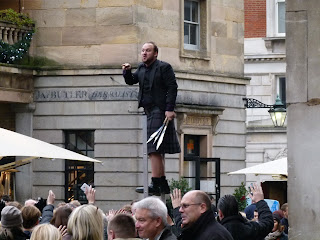
A street entertainer wearing a kilt balancing on top of a ladder while juggling knives, Covent Garden, London
In a kilt. Up a ladder. With knives. Covent Garden entertainment.


Move on from Covent Garden towards Trafalgar Square, another 10 minute walk. Or take the Tube (various options) to Charing Cross. Trafalgar Square's great for people watching, so make sure to spend a few minutes enjoying the view and then pop into the National Portrait Gallery, just round the corner from the National Gallery which fronts onto the Square.

Portraiture isn't really my thing, but the Tudor and Stuart galleries are pretty interesting and probably the only thing I'd personally take in. From there, move on to the National Gallery. Plenty of amazing artwork to go at in here. The majority of the collection is on level 2 - just go straight up the stairs as you come through the main entrance at Trafalgar Square. Take in Van Gogh, Suerat and Monet (rooms 43-45), Caneletto (room 38), Turner's beautiful seascapes (my favourites, in room 34) and Rembrandt (rooms 23-4).

You might be getting a bit peckish by now. There's plenty of cafes around the Square, but I would suggest if it's a reasonable day, grab something to go and sit by the fountains to eat. Again, great for people watching.

From there, hop on the Tube from Charing Cross to Westminster (via Embankment). At Westminster, take a stroll onto the bridge to get those classic shots of Big Ben and the London Eye and then head north past the Houses of Parliament to see Westminster Abbey. It currently costs £20 to get into the Abbey, a price I'm not quite willing to pay, but do have a look inside if you can - I hear it's beautiful.

The Elizabeth Tower or Big Ben, a tall clock tower seen from below a fence, Westminster, London


Carry on walking up Birdcage Walk. This will take you up alongside St James' Park and up to Buckingham Palace. It is always busy round here, but especially so at the Changing of the Guards. Take those selfies (or whatever it is people do at Buckingham Palace) and then head across the roundabout to take the road up past Green Park. If you're a bit lost, look for signs for Hyde Park Corner. At the top of the hill is the huge Wellington Arch.

Wellington Arch, a triumphal arch topped with a bronze figure, near Hyde Park in London


If all that sounds like too much walking - it's about 30 minutes altogether - and you're not too bothered about Buckingham Palace, hop back on the Tube at Westminster and take the District or Circle lines to South Kensington. If you've done the walking, take the Piccadilly from Hyde Park Corner to South Kensington.

During the holidays and weekends, this must be one of the busiest stations on the Tube network and it's because some of London's most popular museums are accessed from it. We're suggesting the Victoria & Albert Museum as your first stop here, purely because the Natural History Museum is best left till late in the day.

So, head up the subway from the station and head into the V&A. Again, you could spend most of the day in here, so we've picked out some highlights. First, the costume gallery (room 40), to the right hand side if you enter through the Exhibition Road doors - a great view of how fashions have changed over the last few hundred years. This will lead you into the Asian galleries. We'll come back to this in a bit, but first head straight across into room 48a to see the amazing Raphael Cartoons - these are full size template drawings to be copied as tapestries. They're in amazing condition given their age. Once you've admired these, head back into the Asian galleries, making sure to check out the Islamic Middle East section (room 42) and from there go onto the Cast Courts (rooms 46a and 46b). These are full of various replicas, including a plaster copy of Trajan's Column.
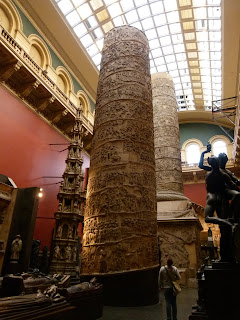
Tall column of plaster with figures in relief, a copy of Trajan's Column at the V&A, London


History and art fix filled? Tired? Why not take a break in the V&A's awesome cafe. It gets busy, but if you've got time, it's worth it for the joy of eating in this room.

Highly decorated columns and painted ceiling with globe light fittings, V&A Museum, London


Awesome, right?

Anyway, head now up Exhibition Road away from the station. A 10 minute walk will bring you to the top where you need to turn left. You should see the Royal Albert Hall. Cross the road to get a better view of it and of the Albert Memorial which stands opposite. There's nothing to do here, just a nice view and we've tried to bring you to the Natural History Museum as late as possible.


On which note, we now need to head back down Exhibition Road, towards South Kensington Station. The Natural History Museum is on your right near the end of the road. Take the Exhibition Road entrance into the Earth Galleries. Take the escalator all the way up to the top floor and have a wander around the Volcanoes & Earthquakes area. Have a go on the Kobe earthquake simulator - great fun for kids (and adults, let's be honest).

An escalator going into a globe at the Natural History Museum, London
Into the bowels of the Earth...


Head back down to the ground floor and take a walk through the Green Zone. You should end up in a corridor full of fossil marine reptiles - one of my favourite parts of the museum. If you want to see the Natural History Museum's famous dinosaurs, now is the time. Cross the main entrance hall and enter the Dinosaur Gallery on your left. If it's late on in the day you should be able to enjoy the gallery at your own speed. If you've timed it wrong, you'll just get swept along in an irritable crowd.

The final suggestion I'd make for the Natural History Museum is the Darwin Centre. This is always quieter than the rest of the museum, but if you get creeped out by things floating in jars, it might not be for you. You've been warned.

That completes our suggestions for seeing London's highlights in a day. Obviously, these are just our ideas of what constitutes the highlights and I'd love to hear what others would include. Aside from the Tube, all the places included here are free entry. The Tube will be cheaper if you buy either a travelcard or get an Oyster Card. You'll also find getting on the Tube easier if you move down to the end of the platforms - the end carriages are quieter.

So, what do you think? What are your London highlights?

Friday, 27 November 2015

London: Ways to spend a day

I'm in London at the moment. It's lovely (discounting the Tube, which is hellish as always). I'm here with my sister and we're finding some interesting ways to spend the day. I thought I'd share a few with you.

1. Seek out new museums

Well, not so much new as less-visited. The Natural History Museum, National Gallery and British Museum are wonderful and we'll probably end up there at some point during this trip, but for the most part we're trying to find more unusual places. Things like the Old Operating Theatre at London Bridge and the Fan Museum at Greenwich. You can easily spend a whole day strolling around a few of these little gems.

2. People watching

London is amazing for people watching. Just find yourself a good vantage point and enjoy the view. Trafalgar Square is good (mostly for watching other tourists) along with Leicester Square. If you don't fancy sitting outside and want a bit more comfort, you can go and find yourself a window seat in a cafe and just watch the world go by.


3. Explore the Tube

Grab yourself a day pass (or an Oyster Card) and go. OK, so it's a little bit geeky, but there's some interesting little stations dotted around the Tube network. You could try hopping off at the next station down from the one you planned and then explore that area instead. Might find a cool new cafe or shop or a little piece of London history.

4. Explore on foot

Alternatively, skip the Tube entirely. Try to get between the places you'd planned on your own two feet. You'll see more of the city and you might just come across something new. That's how I came across Lincoln's Inn Fields earlier in the year, although I was sort of looking for the Hunterian Museum as well. Nice little park to stop and sit a while.

5. See the highlights

OK, so everyone’s going to have different highlights, but if you pick just a few you can easily get round the best bits in a day. This is probably easier for those who’ve visited London before and know what they want to see, but I’d recommend a couple of specific galleries from the museums, a stroll through one of the parks and a trip to Trafalgar Square for the people watching.

There’ll be a post in the next week or so of my pick of London’s highlights, but if you’ve got your own and you think others should know about them, why not leave a note in the comments?

Wednesday, 25 November 2015

Why I Won't Be Scared

I'm going to London tomorrow. Enjoying a super long weekend with my sister. We're going to search out some little museums and poke around in little nooks of the city.

In the wake of the awful attacks on Paris recently, several colleagues have questioned why I'm still going. Won't I feel unsafe? Aren't I scared that something bad will happen?

To which my answer is no. I won't. For the following reasons.

1. What are the chances?

By all means, the threat of a terrorist attack on London is high. But it is a threat only. And if something does happen, how likely is it that I personally will be involved? There's several million people in London at any one time. The chances of any single person being caught up in a terrorist attack is very low. The figures I can find are for folks from the US, but basically I'm many hundreds of times more likely to be killed in a car crash than I am in an act of terrorism. Yeah.

2. I am careful

I'm not a suspicious person, but I'm not stupid enough that I wouldn't know a dangerous situation if I saw it. I'm much more concerned about general crime (pickpocketing and the like) than I am about terrorists in London.

3. I will not be scared

The whole point of terrorism is to instill terror in people. To make them feel unsafe in their own territory. To turn them against their fellow citizens (and refugees, but that's for another day). I refuse to be scared by these people. It would feel like giving in. That's what they want and I refuse.

So yes, I am going to London tomorrow. I will be my usual careful self and have to suppress anxiety on the Tube, but I will enjoy myself and I will make the most of my time off.

The terrorists can go fuck themselves.